
In the high-stakes environments of law enforcement, defense, and government security, accountability is not merely a logistical requirement; it is a foundational pillar of public safety and institutional integrity. Yet, for many organizations, the systems used to manage their most critical assets—lethal weapons—remain dangerously antiquated.
When a firearm goes missing or is misused, the immediate concern is physical recovery. However, the true cost of these failures extends far beyond the replacement value of a single piece of hardware. Organizations often overlook the compounding financial, operational, and reputational damages that stem from poor weapon accountability. As we move further into a data-driven era, the transition from manual oversight to an IoT asset tracking framework is no longer a luxury—it is a strategic necessity for risk mitigation.
The Mirage of Control: Why Manual Systems Fail
Many armories still rely on legacy methods: paper logbooks, manual spreadsheets, or basic barcode scanning. While these systems provide a surface-level sense of order, they offer no real-time visibility or proactive protection.
Manual logbooks are inherently flawed due to human error. A missed signature, an illegible serial number, or a forgotten entry creates a “data ghost”—a gap in the chain of custody that may not be discovered until a formal audit occurs months later. These systems are reactive by design. They tell you what happened in the past, often when it is too late to intervene.
In a large-scale military armory tracking environment or a busy police precinct, the sheer volume of daily check-ins and check-outs renders manual tracking impossible to maintain with 100% accuracy. When accountability is reliant on a distracted officer or a busy armorer, the system is fundamentally broken.
The Financial Burden of Missing Assets
The most obvious cost of poor tracking is the loss of the asset itself. High-grade firearms, optics, and tactical equipment represent a significant capital investment. However, the “hidden” financial costs are much steeper.
When a weapon is reported missing, the operational response triggers a massive internal drain on resources. Man-hours are diverted from active duty to conduct exhaustive physical searches. Internal affairs or specialized investigative units must be mobilized. If the loss is attributed to negligence or systemic failure, the organization may face significant legal liabilities, including civil lawsuits or fines for non-compliance with federal or state mandates.
Furthermore, insurance premiums and departmental budget allocations are often tied to risk profiles. A history of poor firearm compliance and frequent losses signals a high-risk environment, leading to increased costs and tighter budgetary scrutiny from governing bodies.
Operational Paralysis and Investigation Delays
Efficiency is the lifeblood of law enforcement and defense operations. Manual tracking slows down every aspect of weapon management. During a shift change, officers may spend twenty to thirty minutes waiting for manual verification and logbook entries. In an emergency deployment scenario, these delays can have catastrophic consequences.
When an incident occurs involving a specific weapon, the speed of the investigation is critical. With manual records, establishing a clear chain of custody—knowing exactly who had the weapon, when they had it, and where it was last verified—can take days of auditing physical records. This delay hampers the ability of leadership to respond to misuse or unauthorized access effectively.
By contrast, an armory management system powered by IoT provides instant forensic data. The ability to pull a digital history of an asset in seconds, rather than days, transforms the speed of internal investigations and operational adjustments.
The Erosion of Public Trust and Reputational Risk
For law enforcement and government agencies, reputation is currency. The public expects these organizations to maintain the highest standards of discipline and control. News of a lost or stolen service weapon due to administrative oversight is a “high-signal” failure that erodes community trust.
Once public trust is damaged, it is notoriously difficult to rebuild. It leads to increased political pressure, more frequent external audits, and a tarnished brand that can affect recruiting and retention. The reputational damage of a single firearm ending up in the wrong hands because of a tracking failure is a cost that cannot be quantified on a balance sheet, yet it can haunt an organization for years.
How IoT and RFID Redefine Accountability
NexGen IoT was founded on the principle that when accountability becomes measurable, losses disappear. We solve the challenges of firearm management by replacing human-dependent logs with automated, sensor-based intelligence.
The core of this transformation is RFID weapon tracking. By embedding specialized, tamper-resistant RFID tags into or onto firearms, every asset becomes a “smart” node within the facility. Unlike barcodes, which require line-of-sight scanning, RFID allows for bulk scanning and real-time detection without manual intervention.
WeaponTracker™: The New Standard in Armory Management
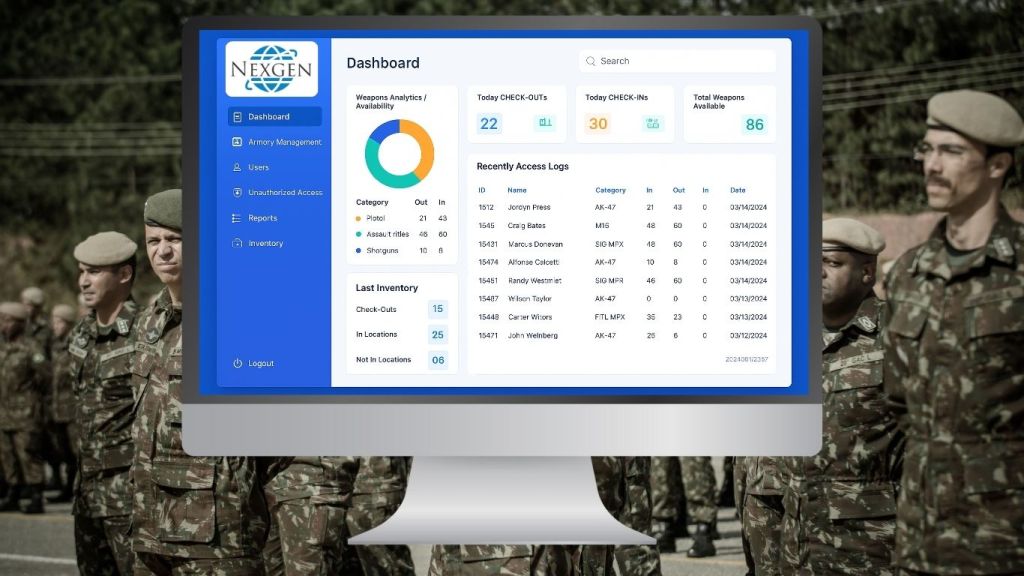
Our WeaponTracker™ platform is designed to integrate seamlessly into existing armory workflows, providing a comprehensive digital layer of protection. It addresses the “hidden costs” of firearm management through several key operational capabilities:
- Automated Check-in / Check-out: When an officer enters the armory, the system identifies the individual and the specific weapon they are carrying via RFID sensors. The transaction is logged automatically in milliseconds, ensuring a 100% accurate, timestamped record without the need for a pen or a keyboard.
- Real-Time Location Visibility: WeaponTracker™ provides administrators with a bird’s-eye view of their entire inventory across multiple facilities. If a weapon is moved from its designated zone without authorization, the system detects the movement instantly.
- Proactive Alerts for Anomalies: Rather than waiting for an audit to find a problem, the system generates real-time alerts. If a weapon has not been returned by a specific time, or if an unauthorized person attempts to access a secure rack, leadership is notified immediately.
- Audit Readiness: Organizations using digital weapon tracking report up to an 80% reduction in audit time. Instead of weeks of manual counting, a full armory audit can be completed in minutes with a handheld RFID reader or fixed portals, ensuring constant firearm compliance.
Risk Prevention Before the Incident
The true value of a sophisticated firearm tracking system is not just in recording data, but in preventing incidents before they occur. By establishing a “geofence” around the armory or facility, NexGen IoT ensures that no weapon leaves the premises unless it is assigned to an authorized user.
This level of law enforcement weapon accountability changes the culture of the organization. When personnel know that every movement of an asset is being monitored and logged by an objective, automated system, the likelihood of “casual” negligence or intentional misuse drops to near zero.
Furthermore, our platform provides deep chain-of-custody visibility. We don’t just track the weapon; we track the lifecycle of the asset—including maintenance schedules, firing counts, and inspection history. This holistic approach ensures that every weapon in the field is not only accounted for but is also safe and functional for the person carrying it.
Scaling Security Across the Enterprise
One of the greatest challenges for defense contractors and large-scale government organizations is scalability. Managing ten weapons is simple; managing ten thousand across twenty different sites is a logistical nightmare.
The NexGen IoT architecture is built for this complexity. Our cloud-based or on-premise deployments allow for centralized visibility of decentralized assets. A commander at headquarters can monitor the inventory status of a remote facility in real-time, ensuring that standardized compliance protocols are being met globally. This eliminates the “siloed” data problem where one facility’s failure remains hidden from the rest of the organization.
Conclusion: Making Accountability Measurable
The transition from manual processes to an IoT asset tracking solution moves organizations from hoping for compliance to guaranteeing it. The hidden costs of weapon loss—litigation, lost man-hours, investigation delays, and damaged public trust—are too significant to ignore.
At NexGen IoT, we believe that technology should serve as a silent, unfailing partner in your security operations. By implementing a robust weapon tracking software solution like WeaponTracker™, you are not just buying a tool; you are investing in a future where firearm loss is a relic of the past.
When your assets are visible, your risks are manageable. When your accountability is measurable, your organization is secure.

Ted Kostis, President & CEO, NexGen IoT Global
RFID and IoT pioneer helping organizations reduce risk through intelligent asset-tracking solutions.