
In the theater of modern defense and law enforcement, the only constant is the speed of change. For decades, the paradigm of Security IoT was defined by a simple question: “Where is my asset?” We answered this through the incremental adoption of Global Positioning Systems (GPS) and Radio Frequency Identification (RFID). These technologies revolutionized the industry, moving us away from paper logs and manual counts into the era of digital visibility.
However, as we stand on the precipice of a new era, visibility is no longer the endgame. In a landscape defined by asymmetric threats, rapid mobilization requirements, and stringent regulatory oversight, knowing the location of a firearm or a piece of tactical equipment is merely the baseline.
The shift we are currently witnessing—and driving at NexGen IoT Global—is the transition from passive tracking to predictive intelligence. We are moving beyond the “where” and “what” to the “how” and “why.” The future of defense IoT solutions lies in the ability to anticipate needs, detect anomalies in real-time, and ensure mission readiness before a single asset leaves the armory.
Why GPS & RFID Alone Are No Longer Enough
To understand where we are going, we must acknowledge the inherent limitations of the legacy systems that brought us here. While GPS and RFID remain foundational, they are increasingly insufficient for modern, high-stakes environments.
The Problem of Contextual Blindness
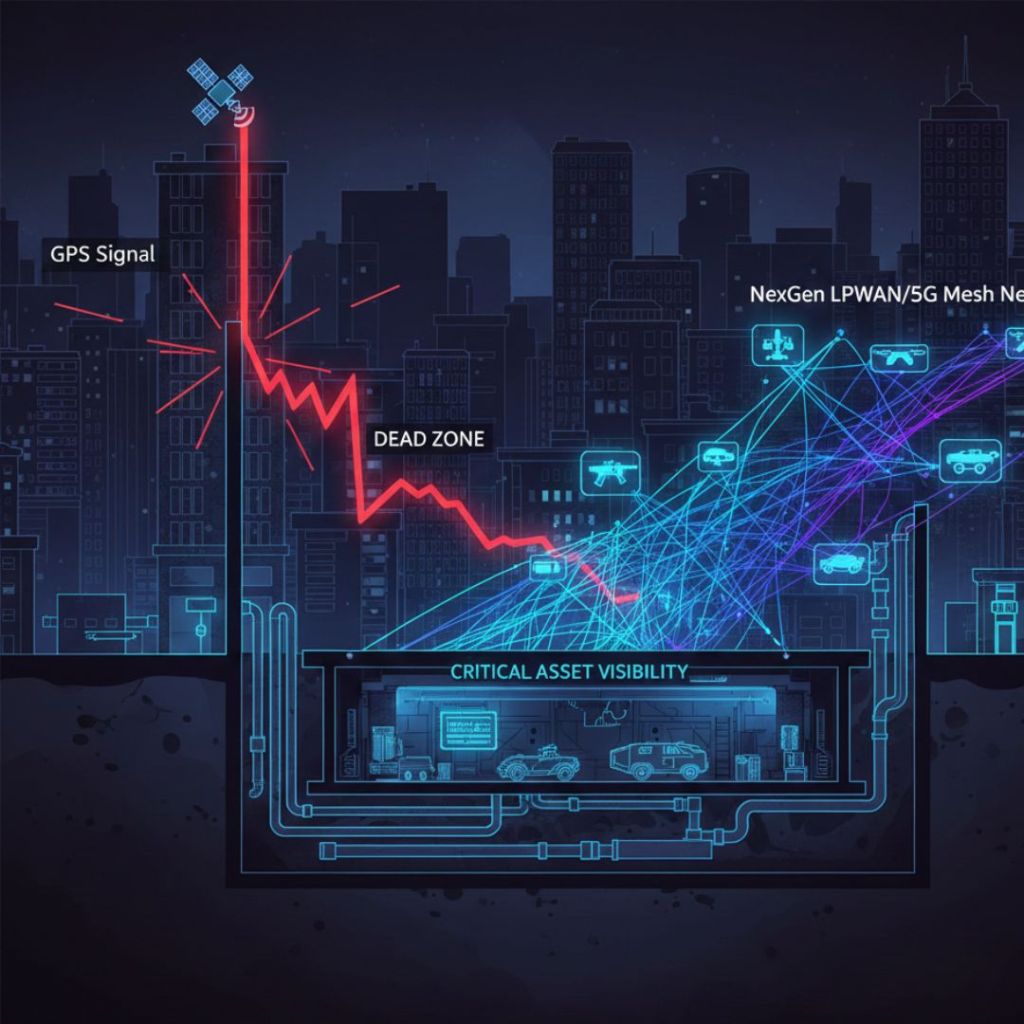
Standard RFID is a “point-in-time” technology. It tells you an item passed a portal, but it offers no data on what happened between point A and point B. Similarly, GPS is often hampered by line-of-sight requirements. In the “urban canyons” of major cities or the reinforced concrete of a subterranean intelligent armory, GPS signals often fail, creating “dark zones” where critical assets vanish from the digital map.
Latency and Infrastructure Dependency
Traditional IoT deployments often rely heavily on centralized cloud processing. In a tactical or emergency response scenario, the seconds lost to high-latency data transmission can be the difference between a successful operation and a catastrophic failure. Furthermore, a weapon tracking system that depends entirely on public cellular infrastructure is vulnerable to both environmental interference and intentional jamming by adversaries.
Reactive vs. Proactive Security
Perhaps the greatest limitation of legacy systems is their reactive nature. They notify you only after someone breaches a perimeter or an asset goes missing. In the context of law enforcement IoT, reactive security is a liability. The modern mandate is prevention through proactive intelligence.
The next generation of military asset tracking and security is being built on a stack of convergent technologies that turn “dumb” objects into “thinking” nodes within a global intelligence network.
Key Emerging Technologies Shaping the Future of Security IoT
The next generation of military asset tracking and security is being built on a stack of convergent technologies that turn “dumb” objects into “thinking” nodes within a global intelligence network.
AI & Predictive Analytics: The End of the “Blind Spot”
Artificial Intelligence is the brain of the new Security IoT ecosystem. By applying machine learning to the massive datasets generated by sensors, we can now implement behavioral modeling.
For example, an advanced armory management system can learn the standard patterns of weapon movement during a shift change. If personnel check out a high-value asset at an unusual time or in an abnormal combination, the system identifies the anomaly before the asset leaves the facility. Predictive security analytics enable commanders to forecast risk and maintenance needs, ensuring every weapon remains accounted for and fully operational.
Edge Computing: Intelligence at the Tactical Front
The future of Security IoT is decentralized. Edge computing processes data locally—on the device or within the armory—instead of sending it to a distant server.
In tactical environments, this means real-time decision-making without cloud latency. If a secured container is tampered with in a remote location with zero connectivity, the “Edge” intelligence can trigger local lockdowns or alerts autonomously. This ensures real-time security intelligence remains functional even in “denied” or “disconnected” environments.

Blockchain: Immutable Accountability
For smart weapon management, the chain of custody is everything. Blockchain technology provides an immutable, decentralized ledger for every asset. The system cryptographically signs and records every cleaning, firing, or transfer event. This creates a tamper-proof audit trail that is essential for legal compliance and operational integrity in defense IoT solutions. It eliminates the possibility of “ghost” inventory or unauthorized record alteration.
5G & LPWAN: The New Connectivity Backbone
While 5G provides the high bandwidth and low latency required for real-time video and massive sensor arrays in urban environments. LPWAN (LoRa, NB-IoT) is the unsung hero of remote security. These low-power, long-range networks allow for military asset tracking over vast distances. They also work through dense structures where cellular and GPS fail. This dual-path connectivity ensures resilience during network disruptions or active electronic warfare.
From Asset Tracking to Intelligent Armories
The culmination of these technologies is the move toward the Intelligent Armory System. This is no longer a storage room; it is a holistic, sensing environment.
By utilizing sensor fusion, we combine data from biometrics, motion sensors, environmental monitors (temperature/humidity for ammunition storage), and RFID/BLE tags. This creates a 360-degree view of operational readiness.
- Automated Compliance: The system automatically logs every interaction, ensuring that only certified personnel can access specific calibers or systems.
- Predictive Readiness: By tracking the “firing life” and maintenance cycles of equipment via integrated sensors, the system alerts armorers to potential failures before they occur in the field.
- Real-Time Alerts: Instant notifications are sent to command staff if unauthorized patterns are detected, transitioning the armory from a passive storage site to an active participant in the facility’s security posture.
Subscribe to receive
the next blog…
How NexGen IoT Global Is Leading This Evolution
At NexGen IoT Global, we don’t just build trackers; we build mission-critical intelligence ecosystems. We base our philosophy on the understanding that in defense and law enforcement, “good enough” fails.
Our approach to next-generation IoT security focuses on the fusion of hardware ruggedness with software intelligence. We prioritize:
- Mission-Critical Reliability: Our systems are designed to operate in the harshest environments, from high-humidity armories to the kinetic edge.
- Operational Intelligence: We provide decision-makers with a “single pane of glass” view of their entire arsenal, providing clarity amidst the noise of big data.
- Uncompromising Accountability: We understand that every tracked asset represents a massive responsibility. We build our solutions to exceed the most stringent compliance standards in the world.
We are not just keeping pace with the industry; we are defining the standard for IoT for defense.

Future Outlook: The Next 5–10 Years
The horizon of Security IoT holds a vision of a fully predictive defense infrastructure. Within the next decade, we will see:
- Autonomous Security Decisions: IoT systems that can initiate lockdown protocols or re-route logistics autonomously based on real-time threat assessments.
- Zero-Trust Physical Security: A world where identity and intent are constantly verified by ambient sensors, ensuring that assets are only accessible to the right person at the precise moment of need.
- AI-Driven Compliance: Systems that not only record data but also understand the nuances of international and local regulations, automatically preventing non-compliant movements or transfers.
Conclusion: A Vision for What’s Next
The transition from the tracking of the past to the intelligence of the future is not a luxury—it is a necessity. As the complexity of the global security landscape increases, our tools must become smarter, faster, and more resilient.
At NexGen IoT Global, we provide the next-generation IoT security that defense and law enforcement professionals require. We help them do their jobs safely and effectively. We are moving beyond the tag and the reader to create a world where every asset is an intelligent node. This node exists in a secure, transparent, and predictive network.
The era of basic tracking is over. The era of connected intelligence has begun.

Ted Kostis
By Ted Kostis, Co-Founder of NexGen IoT Global and former owner of Silent Partner Technologies